Older architecture throughout Lowell presents specific structural vulnerabilities that stinging insects exploit during spring and summer nesting cycles. Historic balloon-framed multi-family units in The Acre,…
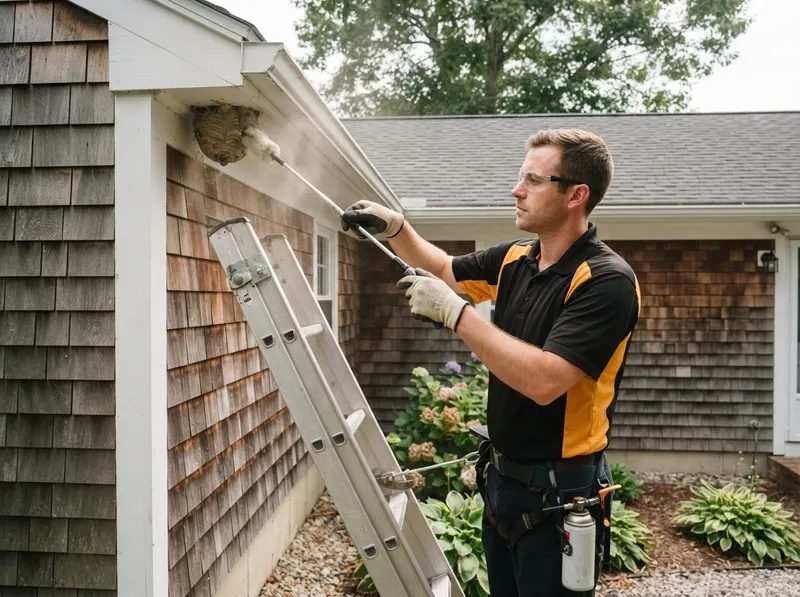
Older architecture throughout Lowell presents specific structural vulnerabilities that stinging insects exploit during spring and summer nesting cycles. Historic balloon-framed multi-family units in The Acre, Highlands, and Back Central frequently feature unsealed soffits, open cornice returns, and degraded mortar lines. European paper wasps and yellowjackets establish harborage behind decorative wooden fascia, inside attic vents near Merrimack River damp zones, or beneath slate overhangs common to Belvidere Victorian builds. Aerial bald-faced hornets construct large carton nests within dense tree canopies bordering the Concord River Greenway and Shedd Park, frequently extending territorial flight paths into adjacent family backyards.
Effective eradication requires species-specific intervention rather than broad-spectrum broadcast spraying. If a nest is located inside an exterior wall cavity along a Centralville three-decker, injecting pressurized aerosol dust directly into the primary flight portal neutralizes the brood without driving defensive workers through interior baseboards into living areas. Conversely, if an exposed paper wasp umbrella nest occupies an open porch beam in Downtown Lowell or Sacred Heart, direct mechanical removal coupled with a residual barrier repellent halts secondary rebuilds. The operational trade-off centers on physical accessibility versus structural remediation: exterior aerial nests hanging from low branches permit direct removal in under 45 minutes, whereas colonies embedded within exterior wall cavities require specialized void treatments that maintain historic facade integrity while eliminating the reproductive queen.
Zandrix Insect Defense executes a systematic protocol across all Middlesex County service calls: 1. Identification of the insect species and mapping of all primary and secondary flight access portals across the building envelope. 2. Application of targeted, micro-encapsulated formulations or dry insecticidal dust directly into the primary nest aperture. 3. Physical detachment and sanitary bagged removal of all accessible exterior carton structures. 4. Application of biological boundary repellents around eaves, rafter tails, and window casings to deter satellite queen colonization. 5. Structural sealing recommendations to permanently eliminate the structural void.
Every job gets a firm, written price after a free on-site visit.
Tell us about your stinging insect nest removal job in Lowell and we'll send a clear, written quote, usually the same day.
 Zandrix Insect Defense