Older architecture throughout Lowell presents specific structural vulnerabilities due to the native building materials of the Merrimack Valley. Multi-family two-deckers in The Acre and Sacred Heart, along with brick…
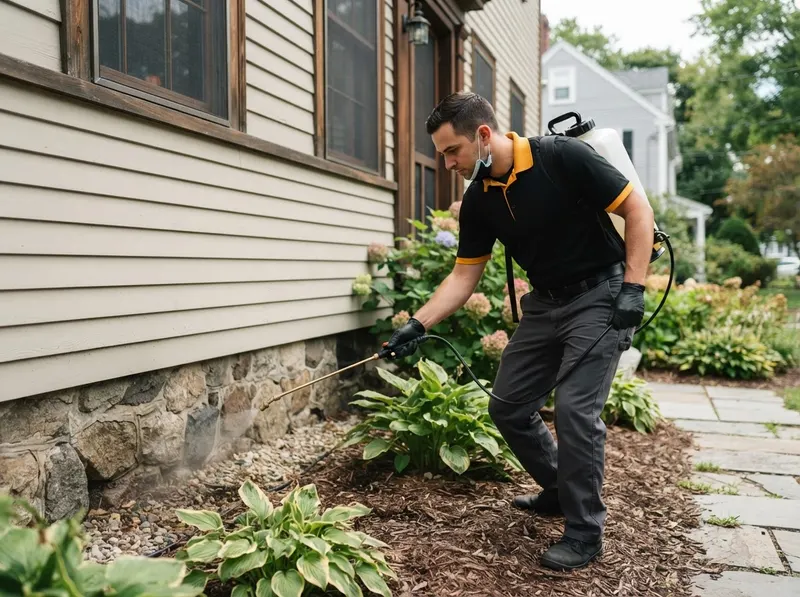
Older architecture throughout Lowell presents specific structural vulnerabilities due to the native building materials of the Merrimack Valley. Multi-family two-deckers in The Acre and Sacred Heart, along with brick rowhouses near Downtown Lowell and the Boott Cotton Mills Museum, typically rest on stacked fieldstone or coarse mortar foundations. As temperature and humidity shift between June and October near the Merrimack River and Concord River Greenway, moisture-dependent insects seek harbourage in ground-floor baseboards and subfloors. Exterior barrier suppression deposits an insoluble microencapsulated formulation against the lowest structural perimeter, maintaining chemical integrity across masonry surfaces without requiring interior broadcast sprays.
Decision guidance requires evaluating the pest entry vector. If active nesting occurs directly within wall voids or beneath finished floors, interior baiting and localized injection must precede perimeter treatments. If the issue involves seasonal migrations, such as spring ant foraging from Shedd Park soil beds or late-summer centipede migrations in Belvidere basements, exterior barrier suppression provides primary containment. The structural trade-off centers on application boundaries: exterior barriers prevent pesticide introduction into interior living spaces and food pantries, but external applications require re-establishment every 60 to 90 days to offset UV degradation and rainwater wash-off from unsheltered rooflines.
Execution follows an exact three-step sequence. Step one involves clearing surface vegetation, leaf litter, and wood mulch 12 inches away from the foundation sill. Step two applies a continuous liquid barrier using low-pressure coarse spray along the vertical foundation face and horizontal perimeter soil band. Step three installs copper mesh or silicone-based elastomeric sealants into visible gaps larger than one-quarter inch around gas meters, water intakes, and cable entries across Back Central, Centralville, and Highlands foundations.
Every job gets a firm, written price after a free on-site visit.
Tell us about your seasonal exterior barrier suppression job in Lowell and we'll send a clear, written quote, usually the same day.
 Zandrix Insect Defense